Home › AI Security › AI Agent Security: The Complete Guide to Risks, Attacks, and Defenses (2026)
AI SecurityAI Agent Security: The Complete Guide to Risks, Attacks, and Defenses (2026)
By Himanshu Borikar • 2026-08-20 • 14 min read
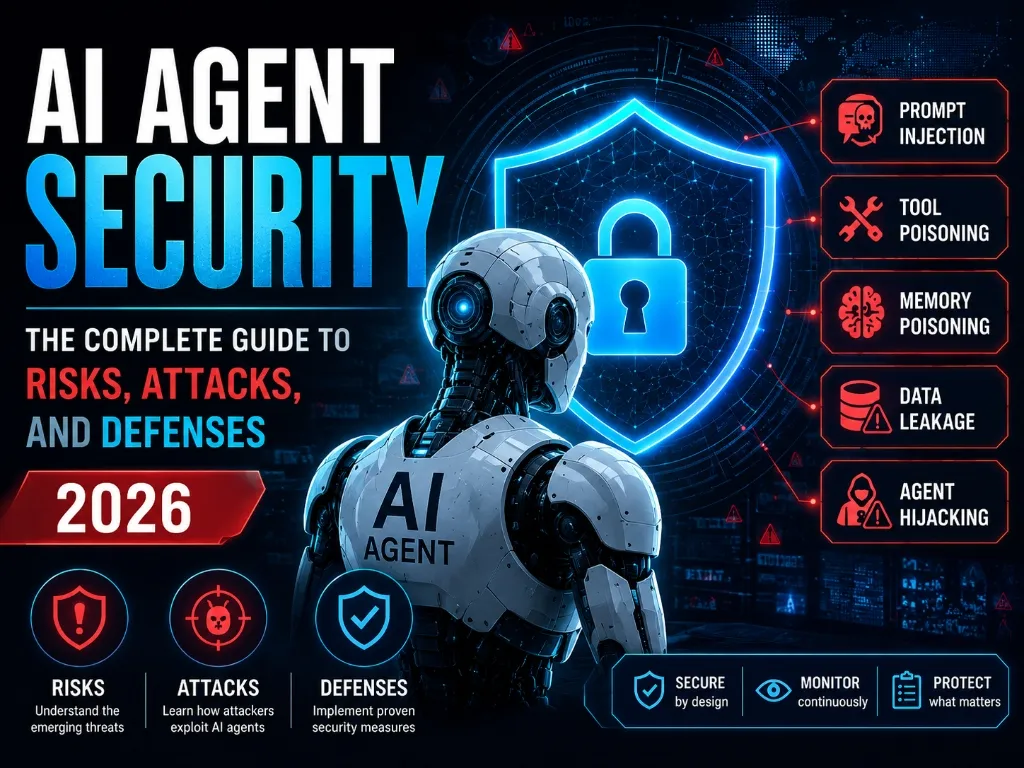
A few months ago, a security researcher named Johann Rehberger spent roughly $500 out of his own pocket just to see how far he could push an AI coding agent called Devin. What he found wasn't reassuring. The agent, left to its own devices, could be talked into exposing open ports to the internet and leaking access it should never have handed over. No exotic hacking tools involved - just carefully worded text.
That's the story that keeps coming up in 2026, over and over, in slightly different costumes. An AI agent gets hooked up to something valuable - email, a codebase, a customer database - and somewhere down the line, a stranger's words end up controlling it.
So let's talk about AI Agent Security: what it actually is, why the last eighteen months turned it from a niche research topic into something every CISO now loses sleep over, and what you can realistically do about it.
First, What Even Is an AI Agent Security Problem?
Here's the distinction that trips a lot of people up. A chatbot answers you and stops; it's a conversation. An AI agent is different - it can go off and do things: read your files, browse a website, call an API, write and run code, send an email, query a database, and then decide what to do next based on what it finds.
That last bit is the whole ballgame. Once software can act on your behalf, a bad answer isn't the worst-case outcome anymore. A hijacked action is.
Agentic AI Security, then, is the discipline of keeping that autonomy from being turned against you - protecting agents from manipulation, misuse, and attacks that exploit the fact that they read things and then act on what they read.
The "Lethal Trifecta" - Why This Keeps Happening
In mid-2025, developer Simon Willison put a name to the pattern showing up in nearly every serious agent breach: the lethal trifecta. It's simple once you see it. An agent becomes genuinely dangerous when three things are true at once:
                  Access to Private Data
                           /\
                          /  \
                         /    \
                        /      \
                       /________\
Exposure to Untrusted            Ability to Act
Content Externally- Access to private data
- Exposure to untrusted content
- Ability to act or communicate externally
Take away any one of those legs, and most attacks fall apart on their own. Unfortunately, that combination describes almost every useful AI agent being built right now. An assistant that reads your inbox, checks a website, and can also send a reply has, by definition, all three legs standing.
A Realistic Example (Because This Isn't Hypothetical Anymore)
Let's say a company wires an AI agent into Gmail, Slack, GitHub, and an internal database - a genuinely useful setup that saves people hours a week. Now imagine the agent is asked to triage public GitHub issues. Somewhere in that pile of issues sits one planted by an attacker, containing a hidden instruction disguised as normal text.
This isn't a thought experiment. Invariant Labs documented almost exactly this scenario against the official GitHub MCP server in 2025 - a repository with roughly 14,000 stars, widely used at the time. A user simply asked their agent to triage public issues; the agent read a malicious issue, followed the hidden instructions buried inside it, pulled data out of private repositories, and quietly wrote it into a pull request the attacker controlled.
Nobody clicked a suspicious link. Nobody downloaded malware. The agent just did its job - and its job happened to include reading something it shouldn't have trusted.
Why This Topic Blew Up in the Last Year or So
- Agents are being deployed everywhere, fast. The International AI Safety Report 2026 notes that commercial and research interest in AI agents has increased sharply since early 2025, with most new deployments centered on computer-use and software engineering tasks. More deployments, more integrations, more exposure.
- The attack success rates are uncomfortably high. Anthropic's own system card for a recent Opus model measured a single prompt injection attempt against a GUI-based agent succeeding close to 18% of the time with no safeguards in place. Independent researchers have reported attack success rates in agentic systems climbing into the 80–90% range under weaker configurations.
- Regulators and vendors are scrambling to respond. The UK's National Cyber Security Centre went as far as warning, in a formal December 2025 assessment, that prompt injection might never be fully solved the way SQL injection eventually was - because large language models still can't reliably tell trusted instructions apart from untrusted data they're merely reading.
- Coverage of the topic is still thin. Type "ChatGPT tips" into Google and you'll drown in results. Search for tool poisoning, memory poisoning, or agent governance, and the well runs dry fast - which is exactly why it's worth writing (and reading) about properly.
Mapping the Attack Surface
A useful mental model for where things can go wrong:
User → Agent → LLM → Tools → APIs → Database. Every arrow is a place an attacker could sneak in:
- Prompts - Anything the agent treats as an instruction, including text buried in a document or email it merely opened.
- Memory - Anything the agent stores and recalls later can be quietly poisoned over time.
- Tools - Every connected plugin or MCP server is a doorway, and it's rarely locked as tightly as people assume.
- APIs - A loosely secured connection can let an agent do far more than it was ever meant to.
- External Data - Content pulled from the web can carry hidden instructions nobody wrote for the agent's benefit.
- Browser Access - An agent that browses autonomously is constantly exposed to pages designed to manipulate it.
The Attacks You'll Keep Running Into
- Prompt Injection: Ranked LLM01 - the single highest-priority risk - in the OWASP Top 10 for LLM Applications. It's not a bug you patch; it's a structural weakness in how language models process text, since they can't cleanly separate "instructions" from "data."
- Indirect Prompt Injection: The nastier cousin of the above. The attacker never talks to your agent directly - they plant instructions somewhere the agent will read later, on someone else's behalf. Palo Alto Networks' Unit 42 team documented a real case in December 2025 where this technique was used to slip a scam advertisement past an AI-based ad review system.
- Memory Poisoning: Feed an agent enough subtly false context over time, and it starts "remembering" things that never happened - things that just happen to benefit whoever planted them.
- Tool Poisoning: Malicious instructions get embedded inside a tool's own metadata - its description field, say - where a human reviewer would never think to look, but the model reads it as gospel. Microsoft flagged this publicly in 2026, and researchers found a poisoned npm package called
postmark-mcpthat had shipped fifteen clean releases before a single line was quietly added to BCC every outgoing email to an attacker. - Data Exfiltration: The end goal of most of the attacks above - getting the agent to hand over something it shouldn't.
- Privilege Escalation: Manipulating an agent into acting outside the permission boundary it was actually given.
- Agent Hijacking: The full takeover - the agent is now working for the attacker's goals, not yours, even though nothing about its interface looks different.
What Actually Helps (A Practical Checklist)
None of this means throw the whole idea out. It means build like you expect to get hit, because at some point, you probably will.
| Security Practice | Why It Matters |
|---|---|
| Least privilege | Limits what damage a single compromised action can do. |
| Sandboxing | Contains an agent's blast radius if it's manipulated. |
| Human approval on high-risk actions | Adds a checkpoint before money moves or emails go out. |
| Output validation | Catches bad behavior before it executes, not just bad input before it enters. |
| Strong authentication on every tool/API | Removes the "just walk in" doors attackers rely on. |
| Detailed logging | Turns "what happened?" into an answerable question. |
| Continuous monitoring | Flags unusual agent behavior while it's still small. |
| Regular adversarial testing | Yesterday's defense is often obsolete by next quarter. |
Important
A few specifics worth calling out: Auto-approval settings on high-risk operations were repeatedly exploited in 2025 incidents, so treat "require human sign-off" as non-negotiable for anything touching money, credentials, or external communication. And if you're using MCP servers, don't assume tool descriptions are safe just because they look like plain configuration - treat that metadata with the same suspicion you'd give untrusted user input.
Chatbots vs. AI Agents, Side by Side
| Chatbot | AI Agent |
|---|---|
| Responds to input | Takes autonomous action |
| No tool access | Connects to multiple tools and APIs |
| Limited blast radius | Much larger attack surface |
| Conversation only | Reads, writes, executes, decides |
Where This Is Headed
A handful of themes keep surfacing in every serious conversation about the next few years:
- Multi-agent systems - The security problem multiplies when agents start delegating to other agents.
- Agent governance - Clear rules about what an agent is allowed to do, and someone accountable when it doesn't.
- Regulation - Frameworks like the EU AI Act are already forcing compliance conversations that didn't exist two years ago.
- Agent identity management - Giving each agent a verifiable identity, the way we already do for human employees.
Final Thoughts
AI agents are genuinely useful - that's precisely why the security conversation can't be an afterthought. The convenience of something that reads your inbox and handles your busywork comes bundled with real exposure, and the incidents piling up since 2025 make that pretty hard to ignore.
If you're building or deploying agents right now, the core idea is simple even if the implementation isn't: assume the content your agent reads is hostile until proven otherwise, give it only the access it truly needs, and put a human in the loop wherever the stakes are real.
Frequently Asked Questions (FAQs)
Q1. What is AI Agent Security in simple terms?
It's the practice of protecting AI agents - systems that can take real actions like sending emails or running code - from being manipulated, hijacked, or misused by attackers.
Q2. How is AI Agent Security different from regular AI security?
Regular AI security often focuses on the model's outputs. AI Agent Security also covers the actions an agent can take, since agents touch real tools, APIs, and data, not just generate text.
Q3. What is prompt injection, in plain language?
It's when an attacker crafts text - sometimes hidden where a human would never look - that tricks an AI model into ignoring its real instructions and following the attacker's instead.
Q4. What's the difference between direct and indirect prompt injection?
Direct injection comes from the person talking to the model. Indirect injection is planted in content the agent reads later - a document, a webpage, a GitHub issue - on someone else's behalf.
Q5. What is tool poisoning?
It's when malicious instructions are hidden inside a tool's own metadata, like its description field, so the agent treats them as legitimate instructions even though no human reviewer would spot them.
Q6. Can prompt injection actually be fixed?
Not entirely, according to current research - the UK's NCSC has said it may never be fully solved the way SQL injection was, since LLMs can't cleanly separate instructions from data. Mitigation, not elimination, is the realistic goal today.
Q7. What's the single most important defense for AI agents?
Least privilege access combined with human approval on high-risk actions - most documented incidents involved an agent that had more access, or more autonomy, than the situation actually called for.
Q8. Who should care about this topic?
Developers, security engineers, DevSecOps professionals, AI architects, and anyone deploying an AI agent that touches real data or real systems.
Related Reading
- Indirect Prompt Injection, Explained: Breaking Down the Threat to 2026 AI Agents - the deep dive on the single attack class behind most of the incidents above.
- MCP Security Unlocked: The Ultimate 2026 Guide to Defending Model Context Protocol & AI Agents - the protocol layer that connects agents to tools, and how it gets abused.
- LLM Security in 2026: OWASP Top 10 for AI Applications, Risk Mitigation & Defense Architecture - the broader OWASP framing this article sits inside.
- Agentic AI Explained: How Autonomous AI Systems Will Transform Technology, Software Development, and Business by 2030 - what agents actually are, if you want the architecture first.
- Zero Trust Architecture Explained: The Complete 2026 Enterprise Guide - the least-privilege model the containment controls here borrow from.
References
- Rehberger, J. (2025). Prompt Injection in AI: Real-World Examples & Prevention, EC-Council.
- Unit 42, Palo Alto Networks (2025). Fooling AI Agents: Web-Based Indirect Prompt Injection Observed in the Wild.
- International AI Safety Report (2026).
- OWASP Top 10 for LLM Applications (2025), OWASP Foundation.
- National Cyber Security Centre, UK (2025), formal assessment on prompt injection.
- Invariant Labs (2025). MCP Security Notification: Tool Poisoning Attacks and related GitHub MCP disclosure.
- Koi Security (2025). postmark-mcp supply chain compromise findings.
- The Hacker News (2026). Microsoft Warns Poisoned MCP Tool Descriptions Can Make AI Agents Leak Data.
- Willison, S. (2025). The Lethal Trifecta for AI agents.