Home › API Security › API Authentication in 2026: A Complete Guide to API Keys, JWT, OAuth 2.1, mTLS & HMAC
API SecurityAPI Authentication in 2026: A Complete Guide to API Keys, JWT, OAuth 2.1, mTLS & HMAC
By Himanshu Borikar • 2026-08-08 • 18 min read
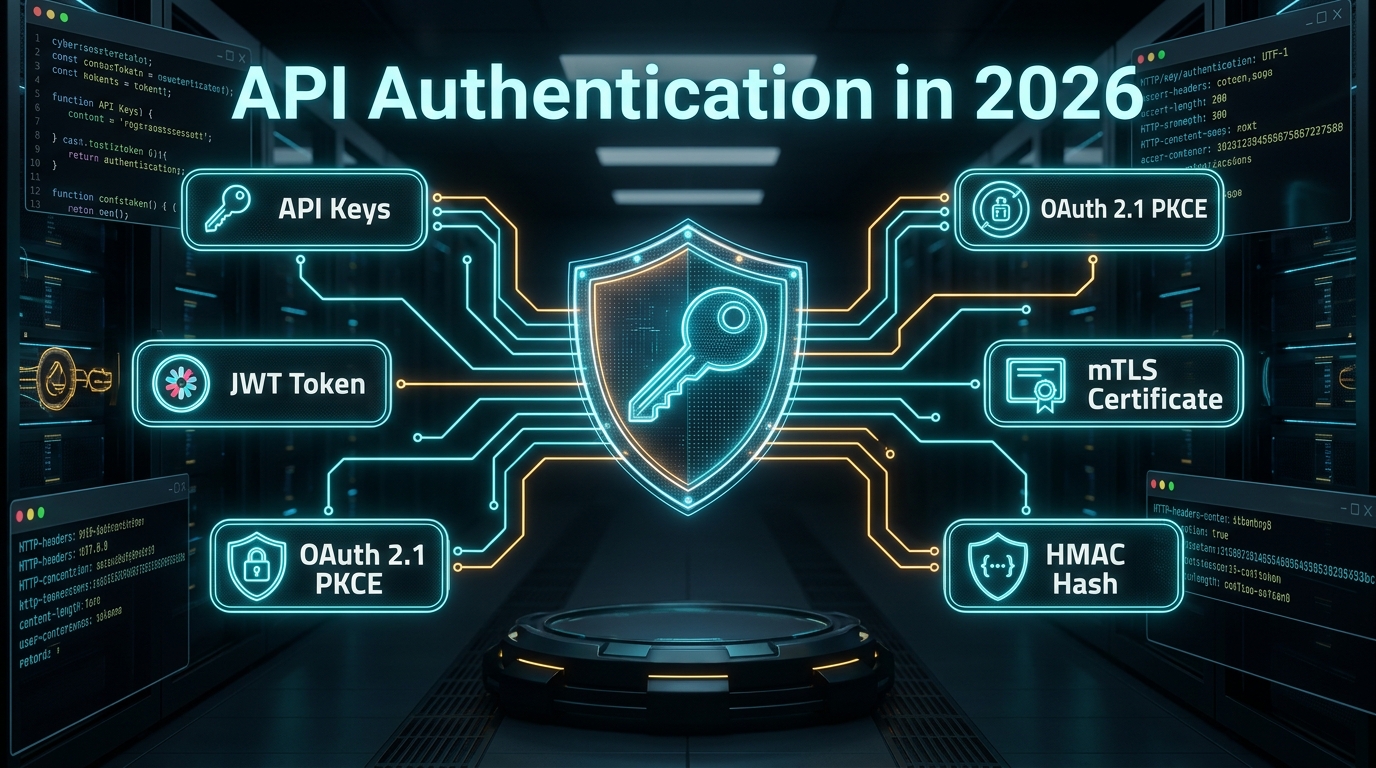
Every API call starts with the same question: who are you, and can I prove it? Get that wrong and nothing else about your security posture matters — access control, rate limiting, and audit logging all sit downstream of authentication.
This guide walks through how API authentication actually works in 2026, where each method shines, where it breaks, and how to pick the right one for your system.
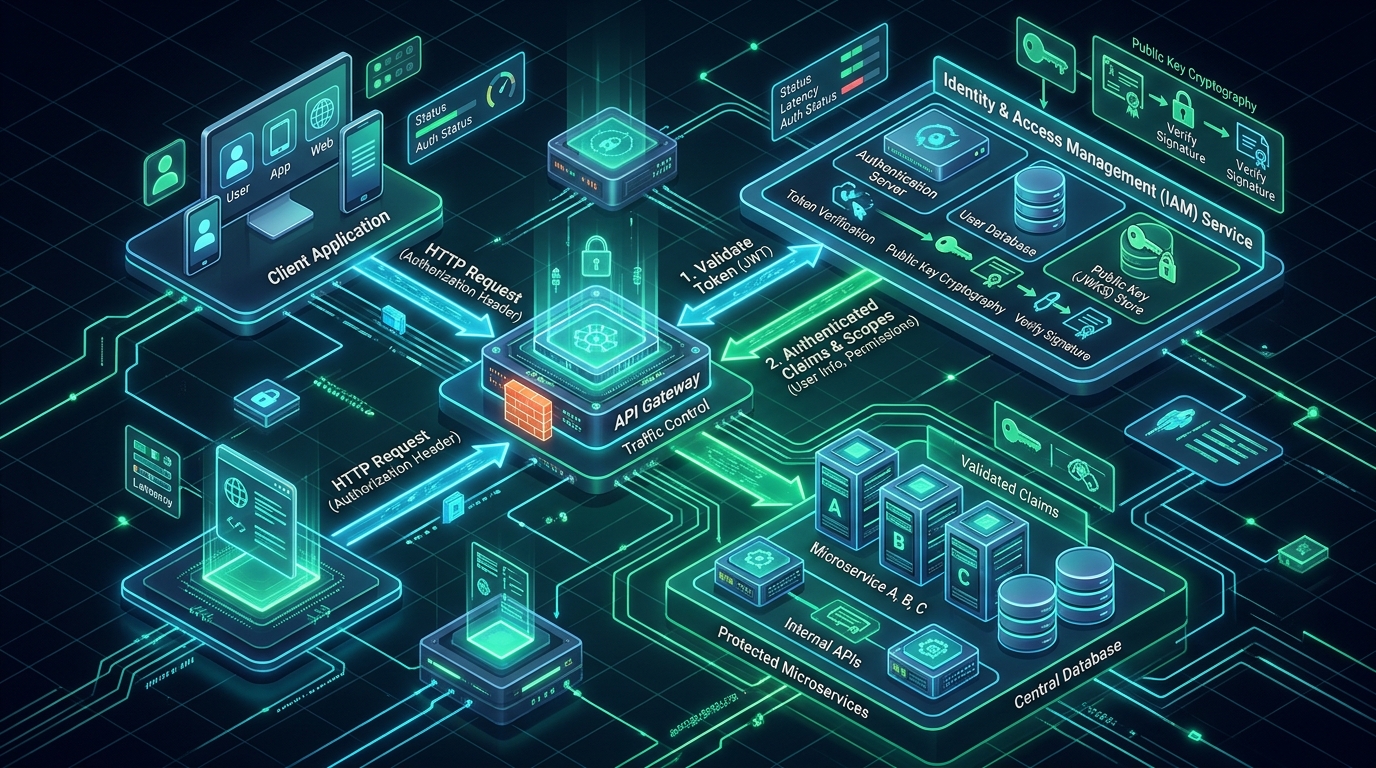
A typical API authentication flow across an API gateway, auth service, and microservice backends.
Why API Authentication Matters in 2026
APIs are no longer a convenience layer — they're the backbone of how software talks to software. A few major industry shifts have made authentication a much bigger deal than it was five years ago:
- Cloud-native apps split monoliths into dozens of services, each with its own API surface and its own chance to get authentication wrong.
- Microservices communicate constantly behind the scenes, and every one of those internal calls is a potential attack path if left unauthenticated.
- Developer platforms now expose public APIs by default, turning what used to be an internal detail into a product surface attackers can probe directly.
- AI APIs — including LLM endpoints and autonomous agents — introduce new machine identities that need credentials, scopes, and revocation just like human users do.
- Third-party integrations mean your security posture now depends partly on how well other people's systems protect the keys and tokens they hold for you.
- Machine-to-machine communication has overtaken human-driven API traffic in many systems, which means authentication has to work without a human in the loop to type a password or approve a prompt.
Important
Weak API authentication is one of the most common root causes behind data breaches reported by security teams — not because the concept is exotic, but because implementations drift, secrets leak, and edge cases get skipped under deadline pressure.
What Is API Authentication?
API authentication is the process of verifying the identity of whoever — or whatever — is making a request to an API. It answers one fundamental question: is this caller who they claim to be?
That caller might be a human logged into a web app, a mobile client, a backend service calling another backend service, a webhook sender, or increasingly, an AI agent acting on someone's behalf.
Authentication doesn't decide what that caller is allowed to do — it only confirms identity. What happens after identity is confirmed is a separate concern: authorization.
Authentication vs Authorization
These two terms get used interchangeably in casual conversation, but they solve completely different problems:
- Authentication (AuthN) answers: Who are you? (e.g., verifying cryptographic proof of identity).
- Authorization (AuthZ) answers: What are you allowed to do? (e.g., evaluating permissions, scopes, and roles).
Real-World Example: When you log into a banking app, authentication confirms you are the account holder — usually via a password plus a second factor. Authorization then determines whether you can view your own balance (yes) or someone else's account (no), and whether you can transfer funds or only view statements.
In API terms: a valid JWT proves who is calling the API (authentication). The scopes or roles embedded in that JWT determine which endpoints that caller can hit (authorization). A system can authenticate someone perfectly and still leak data if authorization checks are missing or misconfigured — which is exactly why both need dedicated attention, not just one combined check.
How API Authentication Works
At a high level, most modern API authentication flows follow the same six-step lifecycle:
THE 6-STEP API AUTHENTICATION LIFECYCLE- Client requests access — by sending credentials (API key, username/password, or client certificate) to an authentication endpoint or including a token on the request itself.
- Server validates the credential — checking a signature, looking up a key in a database, or verifying a certificate chain.
- Server issues or confirms a token/session — often a JWT or opaque token that represents the now-verified identity.
- Client includes that token on subsequent requests — typically in an
Authorizationheader. - Server (or gateway) validates the token on every request — checking signature, expiration, and sometimes revocation status before passing the request downstream.
- Authorization checks run after authentication succeeds — deciding whether the now-known identity can perform the requested action.
The details of steps 1–3 are where API keys, JWT, OAuth 2.1, mTLS, and HMAC diverge from each other. Everything downstream of "here's your token" tends to look similar regardless of which method you chose.
The 5 Core API Authentication Methods
1. API Keys
An API key is a static, unique string a client includes on every request — usually in a header, sometimes in a query parameter. The server checks that the key exists, is active, and maps to a known account.
GET /v1/telemetry/metrics HTTP/1.1
Host: api.layer8sec.com
X-API-Key: l8sec_live_9f83a7c41e0b49d287fa3c
User-Agent: MonitoringDaemon/2.4- Strengths: Simple to implement, easy to issue and revoke individually, works well for identifying which application is calling even when it doesn't need to represent a specific user.
- Weaknesses: No built-in expiration, no user context, and because the key itself is the credential, anyone who obtains it can impersonate the caller indefinitely until it's rotated.
- Best use cases: Public data APIs, internal tooling, rate-limiting and usage tracking by client application, low-sensitivity read-only endpoints.
- Common mistakes: Hardcoding keys in client-side JavaScript or mobile app binaries, committing them to public repositories, passing them in URL query strings where they end up in server logs, and never rotating them.
API keys are acceptable when the risk of exposure is low and the key identifies an application, not a person. They become risky the moment they're used to gate sensitive user data or financial actions — that's a job better suited to token-based authentication with expiration and scope.
// Example: Validating an API Key in Node.js / Express with Timing-Safe Comparison
import crypto from 'crypto';

export function requireApiKey(req, res, next) {
  const providedKey = req.header('X-API-Key');
  if (!providedKey) {
    return res.status(401).json({ error: 'Missing X-API-Key header' });
  }

  // Use timing-safe comparison to prevent side-channel timing attacks
  const validKey = process.env.INTERNAL_API_KEY;
  const isMatch = crypto.timingSafeEqual(
    Buffer.from(providedKey),
    Buffer.from(validKey)
  );

  if (!isMatch) {
    return res.status(403).json({ error: 'Invalid API Key' });
  }
  next();
}
2. JWT (JSON Web Token) Authentication
A JSON Web Token (JWT) is a compact, self-contained token made of three parts, separated by dots: header.payload.signature.
JSON WEB TOKEN (JWT) STRUCTURE ANATOMY- Header — specifies the token type and the signing algorithm (e.g.,
HS256,RS256). - Payload — contains claims: user ID (
sub), roles, scopes, issued-at time (iat), and expiration (exp). - Signature — a cryptographic signature over the header and payload, verifying the token hasn't been tampered with.
Warning
Because the payload is only base64-encoded (not encrypted), anyone can read a JWT's contents — the signature only proves it wasn't altered, not that it's secret. Never put sensitive data (passwords, private keys, credit cards) in a JWT payload.
- Access tokens vs refresh tokens: Access tokens are short-lived (minutes to a couple of hours) and sent with every API request. Refresh tokens are longer-lived, stored more carefully in
HttpOnlycookies, and used only to obtain a new access token when the old one expires — without forcing the user to log in again. - Token expiration matters: Because a stolen JWT is valid until it expires, and JWTs generally can't be revoked individually without extra infrastructure (a blocklist or a short enough lifetime that revocation isn't necessary).
- Common JWT mistakes: Using a weak HMAC signing secret, accepting the
alg: noneheader value, storing JWTs inlocalStoragewhere they are exposed to XSS attacks, setting expiration times too long, and failing to validate theiss(issuer) andaud(audience) claims.
// Example: Validating JWT Signature and Claims using TypeScript
import jwt from 'jsonwebtoken';

interface UserJwtPayload {
  sub: string;
  roles: string[];
  aud: string;
  iss: string;
}

export function verifyApiToken(authHeader: string): UserJwtPayload {
  if (!authHeader.startsWith('Bearer ')) {
    throw new Error('Malformed Authorization header');
  }
  const token = authHeader.split(' ')[1];

  // Verify signature and check audience / issuer
  return jwt.verify(token, process.env.JWT_PUBLIC_KEY!, {
    algorithms: ['RS256'],
    audience: 'https://api.layer8sec.com',
    issuer: 'https://auth.layer8sec.com'
  }) as UserJwtPayload;
}
3. OAuth 2.1 (The Modern Standard)
OAuth 2.1 consolidates years of security lessons learned from OAuth 2.0 into a tighter, more opinionated specification. It removes flows that were routinely misused (like the implicit grant) and makes previously optional protections mandatory.
OAUTH 2.1 AUTHORIZATION CODE FLOW WITH PKCE- Authorization Code Flow with PKCE: The client redirects the user to an authorization server, the user authenticates and consents, and the authorization server redirects back with a one-time code. The client exchanges that code — along with a PKCE verifier — for tokens. PKCE (Proof Key for Code Exchange) prevents a stolen authorization code from being usable by anyone other than the client that started the flow, which matters enormously for mobile and single-page apps that can't keep a client secret truly secret.
- Client Credentials Flow: Used for machine-to-machine communication where there's no human user to authenticate — a backend service authenticates directly with its own client ID and secret to get an access token representing itself.
- Why OAuth 2.1 over older OAuth 2.0 implementations: OAuth 2.1 makes PKCE mandatory for all authorization code flows (not just public clients), drops the implicit and password grant types that encouraged insecure patterns, and requires exact-match redirect URI validation to close open-redirect style attacks. If you're building new infrastructure in 2026, there's little reason to implement legacy OAuth 2.0 flows that OAuth 2.1 has deliberately removed.
4. Mutual TLS (mTLS)
Standard TLS verifies the server's identity to the client. Mutual TLS flips that around too — the client also presents a certificate, and the server verifies it before allowing the connection.
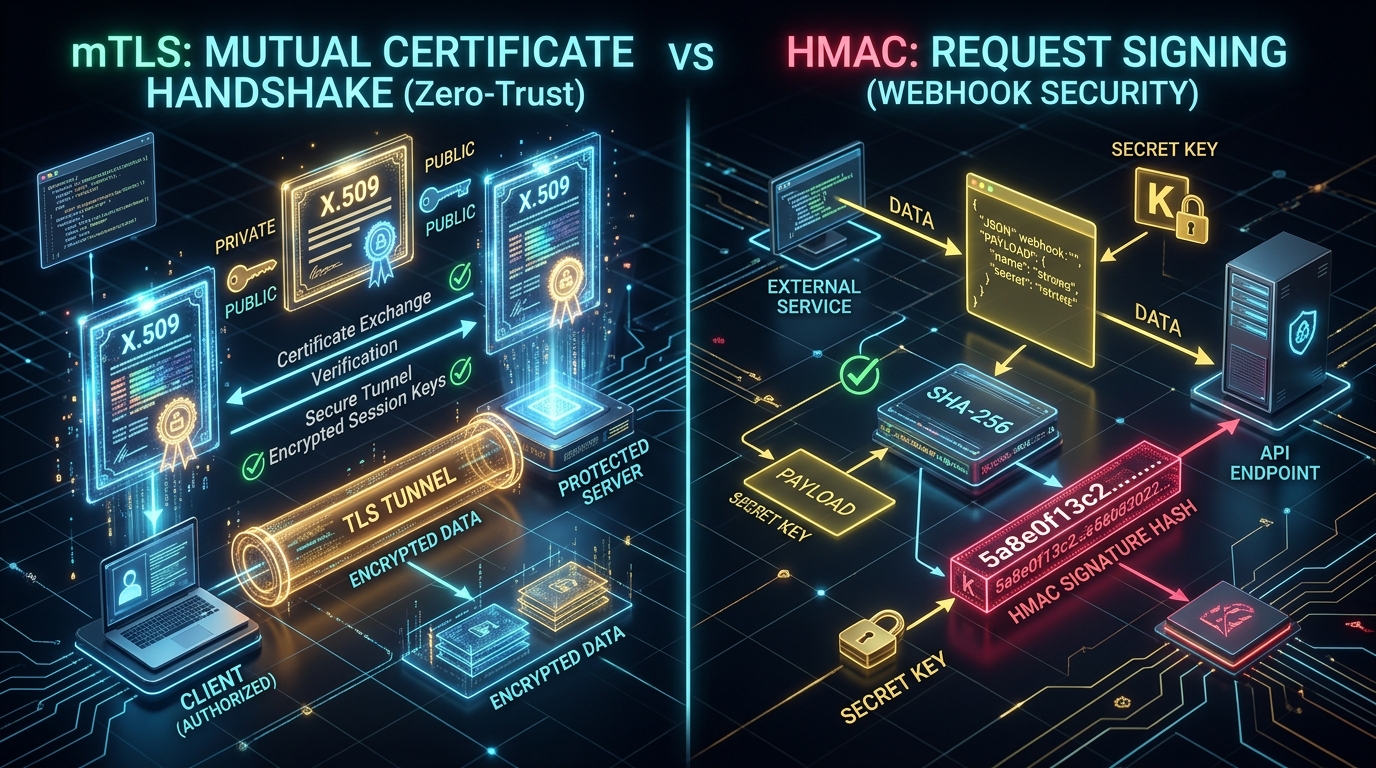
Two-way certificate exchange in mTLS compared with HMAC request payload hashing.
- Certificate-based identity: Instead of a password or token, the client's identity is embedded in an X.509 certificate signed by a trusted certificate authority (CA). The server validates the certificate chain, checks revocation status, and confirms the certificate matches an expected identity before processing the request.
- Service-to-service authentication: mTLS is a natural fit for microservices talking to each other inside a cluster, since certificates can be issued and rotated automatically by a service mesh without any human handling secrets.
- Enterprise and microservices use cases: Financial systems, healthcare data exchanges, and internal service meshes commonly use mTLS because it authenticates at the transport layer, before any application-level request is even parsed — reducing the attack surface for anything that doesn't present a valid certificate.
- Operational cost: mTLS is heavier to operate than a bearer token — certificate issuance, rotation, and revocation require real infrastructure — but for internal, high-trust environments it removes an entire class of token-theft risk, since there's no bearer token to steal in the first place.
# Example: NGINX Reverse Proxy enforcing mTLS client certificate verification
server {
    listen 443 ssl;
    server_name api.internal.layer8sec.com;

    ssl_certificate /etc/ssl/certs/server.crt;
    ssl_certificate_key /etc/ssl/private/server.key;

    # Enforce Client Certificate Verification
    ssl_client_certificate /etc/ssl/certs/internal-ca.crt;
    ssl_verify_client on;
    ssl_verify_depth 2;

    location / {
        proxy_pass http://backend_cluster;
        proxy_set_header X-Client-DN $ssl_client_s_dn;
    }
}
5. HMAC Authentication
HMAC (Hash-based Message Authentication Code) authentication proves both the integrity and the origin of a request by having the client sign it with a shared secret, rather than sending the secret itself.
HMAC-SHA256 REQUEST SIGNING- Request signing: The client computes a hash of the request (method, path, body, timestamp) combined with a shared secret key, and sends that hash alongside the request. The server recomputes the same hash using its copy of the secret and compares. If they match, the request is authentic and untampered.
- Webhook verification: HMAC is the standard way to verify that an incoming webhook actually came from the platform that claims to have sent it — the sender signs the payload, and the receiver validates the signature before trusting the data.
- Replay protection: Because a signed request could be captured and resent by an attacker, HMAC schemes typically include a timestamp or nonce in the signed payload. The server rejects any request with a timestamp too far in the past, or a nonce it's already seen, closing the replay window.
- Network security: HMAC's biggest advantage is that the shared secret never travels over the network — only the signature does. Its biggest operational challenge is secret distribution and rotation between the two parties who need to share it.
# Example: Verifying HMAC SHA-256 Webhook Signature in Python
import hmac
import hashlib
import time

def verify_webhook_signature(payload_bytes: bytes, signature_header: str, secret_key: str, timestamp_header: int) -> bool:
    # 1. Prevent replay attacks: reject timestamps older than 300 seconds
    current_time = int(time.time())
    if abs(current_time - timestamp_header) > 300:
        return False

    # 2. Recompute the expected HMAC signature
    signed_data = f"{timestamp_header}.".encode('utf-8') + payload_bytes
    expected_sig = hmac.new(
        secret_key.encode('utf-8'),
        signed_data,
        hashlib.sha256
    ).hexdigest()

    # 3. Timing-safe string comparison
    return hmac.compare_digest(expected_sig, signature_header)
API Authentication Comparison Table
| Method | Security Level | Implementation Complexity | Performance | Scalability | Best For | Common Risks |
|---|---|---|---|---|---|---|
| API Keys | Low–Medium | Low | High | High | Public/internal tooling, app identification | Leaked keys, no expiration |
| JWT | Medium–High | Medium | High | High | Stateless session auth, SPAs, mobile | Weak secrets, insecure storage |
| OAuth 2.1 | High | High | Medium | High | User-delegated access, third-party apps | Misconfigured redirect URIs, scope creep |
| mTLS | Very High | High | Medium | Medium | Service-to-service, enterprise microservices | Certificate management overhead |
| HMAC | High | Medium | High | High | Webhooks, request signing, partner APIs | Secret distribution, replay attacks |
Common API Authentication Vulnerabilities
Security teams consistently observe the following vulnerabilities across modern API architectures:
- Exposed API keys — committed to public repos, embedded in client-side code, or logged in plaintext.
- Token theft — stolen via XSS, malware, insecure storage, or intercepted over unencrypted connections.
- Weak JWT secrets — short or guessable HMAC signing keys that can be brute-forced offline.
- Replay attacks — captured requests or tokens reused by an attacker without needing to break any cryptography.
- Improper token storage — tokens sitting in
localStorage, unencrypted mobile storage, or version control. - OAuth misconfiguration — overly broad redirect URI matching, missing PKCE, or excessive scopes granted by default.
- Refresh token abuse — a stolen refresh token used to mint fresh access tokens long after the original session should have ended.
- Insecure transport — any authentication scheme, no matter how strong, fails if credentials travel over plain HTTP.
- Hardcoded credentials — secrets baked directly into source code or configuration files checked into version control.
For a broader look at how these risks extend into AI-driven systems, see our guides on AI Agent Security: The Complete Guide to Risks, Attacks, and Defenses and LLM Security in 2026: Protecting AI Applications from Prompt Injection and Data Leaks.
API Authentication Best Practices
- Use HTTPS everywhere — no exceptions, no internal-network shortcuts.
- Keep access tokens short-lived; rely on refresh tokens for longevity.
- Rotate API keys and shared secrets on a defined schedule, not only after an incident.
- Apply least privilege — scope tokens to exactly what the caller needs, nothing more.
- Store secrets in a dedicated secrets manager, never in source code or environment files committed to version control.
- Validate signatures and certificates properly — check expiration, issuer, audience, and revocation status every time.
- Log authentication events (successes and failures) to support detection and incident response.
- Implement rate limiting on authentication endpoints to slow down credential-stuffing and brute-force attempts.
- Prefer mTLS for internal service-to-service communication where the operational overhead is justified by the trust boundary being crossed.
- Use OAuth 2.1 with PKCE for any modern public client — SPAs, mobile apps, and CLI tools alike.
How to Choose the Right Authentication Method
| Scenario | Recommended Approach |
|---|---|
| Public APIs (read-only, low sensitivity) | API keys with rate limiting |
| Internal APIs | mTLS or scoped JWTs behind a gateway |
| Microservices | mTLS, often paired with short-lived JWTs for context |
| Webhooks | HMAC request signing with timestamp/nonce |
| Mobile apps | OAuth 2.1 with PKCE |
| Single-page apps (SPAs) | OAuth 2.1 with PKCE, tokens kept out of localStorage |
| AI APIs / AI agents | Scoped OAuth 2.1 client credentials or short-lived JWTs per agent identity |
| Enterprise platforms | OAuth 2.1 for user delegation, mTLS for internal service mesh traffic |
If you're building anything that spans multiple of these categories — which most real systems do — it's common to layer methods: OAuth 2.1 at the user-facing edge, mTLS between internal services, and HMAC for anything crossing a trust boundary with a partner or webhook consumer. Our guide to Zero Trust Architecture Explained covers how to structure that layering across an entire enterprise environment.
Future Trends in API Authentication
- OAuth 2.1 adoption is accelerating as frameworks and identity providers deprecate legacy 2.0 flows by default.
- Passkeys are moving from consumer login pages into developer platforms, reducing reliance on shared secrets for human-initiated flows.
- Zero trust identity models are pushing authentication checks to every hop in a request path, not just the perimeter — see Zero Trust Architecture Explained for the architectural side of this shift.
- Machine identity management is becoming its own discipline, with dedicated certificate and token lifecycles for services, bots, and pipelines.
- AI agent authentication is an emerging category on its own — agents acting autonomously need scoped, revocable, and auditable credentials distinct from the humans who deployed them. Our MCP Security Unlocked guide digs into how this plays out for Model Context Protocol implementations specifically.
- Stronger service-to-service security is trending toward mTLS-by-default inside service meshes, with token-based auth layered on top for finer-grained authorization.
FAQ
1. What is the difference between API authentication and API authorization?
Authentication verifies who is making a request; authorization determines what that verified identity is allowed to do.
2. Is JWT more secure than API keys?
JWTs support expiration and embedded claims that API keys lack, but security depends on implementation — a poorly signed JWT can be weaker than a well-managed API key.
3. Should I use OAuth 2.0 or OAuth 2.1 for a new project?
For new systems in 2026, OAuth 2.1 is the better default since it makes PKCE mandatory and removes flows that were commonly misused under OAuth 2.0.
4. When should I use mTLS instead of token-based authentication?
mTLS fits best for internal service-to-service traffic in high-trust environments where certificate management infrastructure already exists or is worth building.
5. How does HMAC authentication prevent replay attacks?
By including a timestamp or nonce in the signed payload, so the server can reject requests that are too old or have already been processed once.
6. Can API keys alone be considered secure?
API keys can be secure enough for low-sensitivity, application-level identification, but they shouldn't gate sensitive user data or financial actions without additional controls like scoping and rotation.
7. What's the safest place to store access tokens in a browser?
An HttpOnly, Secure cookie is generally safer than localStorage, since it isn't directly accessible to JavaScript and therefore isn't exposed to typical XSS payloads.
8. Do AI agents need their own authentication method?
Increasingly yes — agents acting autonomously benefit from scoped, short-lived, individually revocable credentials rather than sharing a human user's session or a single static key.
Conclusion
There's no single "best" API authentication method — only the right method for a given trust boundary. API keys work for low-stakes application identification. JWTs give you stateless, scalable session handling. OAuth 2.1 is the right tool when a human needs to delegate access to a third party. mTLS earns its operational cost in high-trust service-to-service environments. HMAC keeps webhooks and partner integrations honest without ever exposing a shared secret on the wire.
The practical move for most teams in 2026 isn't picking one method and forcing it everywhere — it's understanding what each one actually protects against, then layering them deliberately across the parts of your architecture that need them.