Home › Cybersecurity Tools › Metasploit Framework: Complete Guide to Features, Installation, Architecture & Best Practices
Cybersecurity ToolsMetasploit Framework: Complete Guide to Features, Installation, Architecture & Best Practices
By Himanshu Borikar • 2026-07-24 • 16 min read
When cybersecurity professionals discuss penetration testing frameworks, Metasploit is usually the first tool that comes up. It has served as the foundational backbone of authorized security testing for over two decades, giving security auditors, red teamers, and defenders a structured, modular platform to validate whether a known vulnerability is actually exploitable in a target environment - rather than just theoretically present.
Metasploit Framework is a free, open-source penetration testing platform maintained by Rapid7 that organizes exploit code, scanning tools, auxiliary utilities, and post-exploitation modules into a consistent, scriptable console interface. Security engineers and researchers use it to confirm findings from automated vulnerability scanners rather than relying on scanner output alone.
Metasploit is utilized by penetration testers executing authorized client engagements, SOC analysts studying adversary techniques defensively, and cybersecurity students learning the mechanics of vulnerability verification. Learning Metasploit is valuable precisely because it teaches the full lifecycle of a security finding: identify, validate, document, and remediate.
A Necessary Note on Ethics & Legality: Metasploit Framework is a dual-use utility. The exact same modules that validate a client's security posture during a authorized penetration test can cause severe operational disruption if executed against production systems without explicit authorization. This article focuses entirely on defensive understanding, authorized security testing, and lab-based educational verification - not unauthorized exploitation.
Quick Overview & Specification Table
| Attribute | Details |
|---|---|
| Tool Name | Metasploit Framework |
| Developer | Rapid7 (Originally created by H. D. Moore in 2003) |
| Category | Penetration Testing / Exploit Development & Validation Framework |
| License | BSD-Style Open-Source License (Framework); Commercial Rapid7 Products Are Proprietary |
| Latest Release | 6.4.131 Release Series (Weekly Module Updates) |
| First Release | 2003 |
| Supported Operating Systems | Windows, Linux (Kali Linux, Ubuntu, Debian, Fedora, Arch), macOS |
| User Interface | Command-Line Console (msfconsole), with RPC / REST API Access |
| Official Website | metasploit.com |
| Official Documentation | docs.metasploit.com |
| Official Repository | github.com/rapid7/metasploit-framework |
| Pricing | Free Open-Source (Framework); Commercial Rapid7 Products Priced Separately |
| Free Availability | Yes - Full Metasploit Framework is Free and Open Source |
| Commercial Products | Rapid7 InsightVM and Related Enterprise Security Platforms |
| Best For | Vulnerability validation, authorized penetration testing, security research, red/purple team audits |
What is Metasploit Framework?
Metasploit Framework is a free, open-source penetration testing framework that helps security professionals develop, test, and organize exploit code to validate whether identified vulnerabilities are actually exploitable.
H. D. Moore created the original Metasploit project in 2003 as a Perl-based tool, later rewriting it in Ruby. Rapid7, a Boston-based cybersecurity company, acquired the project in 2009 and has maintained and expanded it ever since. The core Framework remains open source under a BSD-style license, while Rapid7 also builds commercial vulnerability management platforms - such as InsightVM - on top of related security technology.
Metasploit works by organizing security testing capabilities into modules - reusable, structured pieces of Ruby code - that plug into a shared console interface (msfconsole). Instead of writing a proof-of-concept exploit from scratch for a known Common Vulnerabilities and Exposures (CVE) ID, a security tester can search Metasploit's module library, configure target options, and execute a structured, repeatable test.
Metasploit Framework vs. Commercial Rapid7 Products
The Metasploit Framework is the free, open-source console-based tool covered in this guide. Rapid7's broader commercial portfolio - including InsightVM - targets enterprise vulnerability management with automated asset discovery dashboards, risk scoring, and reporting capabilities that go well beyond what the open-source console provides on its own.
A typical testing workflow looks like this: a vulnerability scanner or manual assessment identifies a potential flaw, an auditor uses Metasploit to validate whether it is genuinely exploitable in that specific environment, and the confirmed finding is documented for remediation - turning a "possible" scanner alert into a proven technical finding.
Core Components Breakdown
Metasploit Framework is structured around modular components that allow authorized testers to work with known vulnerabilities in a repeatable, well-documented manner:
| Component | Technical Description & Function |
|---|---|
| Modules | The general term for Metasploit's functional building blocks - exploits, auxiliary tools, post modules, encoders, and payloads. |
| Auxiliary Modules | Non-exploit modules used for network scanning, port fuzzing, protocol fingerprinting, and information gathering. |
| Exploit Modules | Structured Ruby code designed to test whether a specific known vulnerability (CVE) exists on a target system. |
| Payload Concepts | Code executed on the target after successful exploitation, providing interactive access or commands in authorized environments. |
| Encoders | Utilities that obfuscate or transform payload bytecode to ensure proper execution across target buffers. |
| NOP Generators | Utilities that generate No-Operation (NOP) instructions used in exploit development buffer alignment. |
| Post Modules | Modules executed after initial access is established to demonstrate security impact and gather system evidence. |
| Database Integration | Connects to PostgreSQL (msfdb) to store scan results, active hosts, service maps, and vulnerability findings. |
| Workspaces | Logical isolation containers inside msfconsole to organize findings and hosts by engagement or project. |
| Console Interface | msfconsole - the primary interactive command-line interface used by security practitioners. |
| Automation Support | Resource scripts (.rc) and REST/RPC APIs for creating automated, repeatable testing workflows. |
Key Features & Capabilities
- Modular Architecture: Swap exploits, payloads, and auxiliary modules effortlessly without rewriting core testing logic.
- Vulnerability Validation: Confirm whether a scanner-reported issue is genuinely exploitable or a false positive.
- Database Integration: PostgreSQL-backed storage (
msfdb) for hosts, services, credentials, and vulnerability findings. - Automation & Scripting: Resource scripts (
.rc) and API integration for repeatable testing workflows and automated scans. - Extensive Module Library: Thousands of community-contributed and Rapid7-maintained modules covering CVEs across decades of software.
- Cross-Platform Compatibility: Runs natively across Windows, Kali Linux, Ubuntu, Debian, Fedora, Arch, and macOS.
- Security Reporting Support: Findings can be organized by workspace and exported to generate evidence-based audit reports.
- Toolchain Integration: Works alongside scanners like Nmap and vulnerability management engines for full-scope workflows.
- Open-Source Ecosystem: Transparent, community-reviewed codebase published under a BSD-style license.
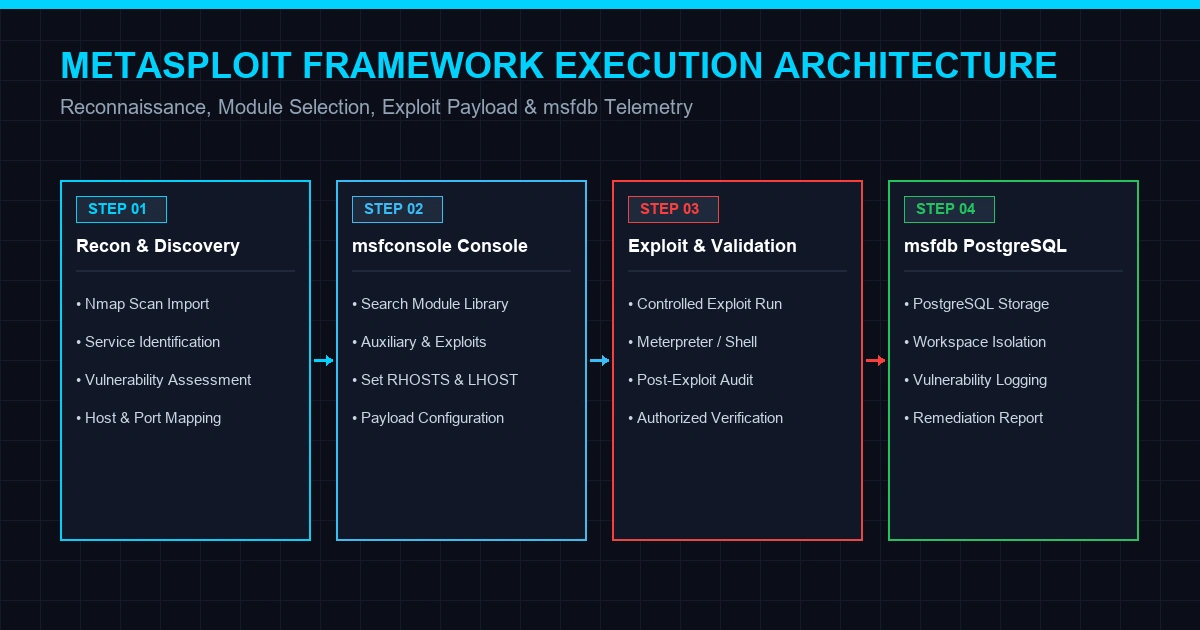
Metasploit Execution Architecture Pipeline
Modern security auditing requires understanding how Metasploit processes user commands, queries its module library, connects to PostgreSQL, and executes tests against target endpoints.
+-------------------------------------------------------------------------------+
|                 Metasploit Framework Execution Pipeline                       |
+-------------------------------------------------------------------------------+
|  [Reconnaissance & Vulnerability Assessment] (Nmap / Vulnerability Scanner)   |
|        |                                                                      |
|        v                                                                      |
|  [msfconsole Interactive Interface] (Module Search / Workspace Isolation)     |
|        |                                                                      |
|        v                                                                      |
|  [Module Configuration] (set RHOSTS, set LHOST, set PAYLOAD)                  |
|        |                                                                      |
|        v                                                                      |
|  [Controlled Execution & Validation] (Auxiliary Check / Exploit Run)          |
|        |                                                                      |
|        v                                                                      |
|  [msfdb PostgreSQL Telemetry & Workspace Logging] (Host & Service Storage)    |
+-------------------------------------------------------------------------------+
Download & Installation Guide
Always obtain Metasploit Framework from the official Metasploit GitHub repository (github.com/rapid7/metasploit-framework) or official Nightly Installers linked from metasploit.com. Avoid unofficial third-party mirrors.
Installation Methods by Operating System
| Operating System | Official Installation Method |
|---|---|
| Windows | Download official Windows installer linked from the Metasploit Nightly Installers page and execute setup. |
| Kali Linux | Pre-installed by default. To update: sudo apt update && sudo apt install metasploit-framework. |
| Ubuntu / Debian | Use official Linux installer script from Rapid7: curl https://raw.githubusercontent.com/rapid7/metasploit-omnibus/master/config/templates/metasploit-framework-wrappers/msfupdate.erb > msfinstall && chmod 755 msfinstall && ./msfinstall. |
| Fedora / RHEL | Use the official Linux installer script from Rapid7 or build from source per official documentation. |
| Arch Linux | Install via AUR (aur/metasploit) or use the official Linux installer script. |
| macOS | Use the official installer script linked from Rapid7's Nightly Installers page. |
Ruby Dependencies & Environment
Metasploit Framework is written in Ruby. Official installer scripts bundle a compatible Ruby runtime environment, so a separate manual Ruby installation is generally not required if using official packages.
PostgreSQL Database Setup (msfdb)
Metasploit uses PostgreSQL to store scan data, host details, and audit findings. Most official packages configure and initialize the database automatically:
- Initialize database manually:
msfdb init - Verify database connection status:
msfdb status - Launch console with active database:
msfconsole
Verifying Installation & Updates
Launch msfconsole and inspect the banner string displaying the active Framework version, or execute msfconsole -v. To update module libraries, run msfupdate or update through your package manager (sudo apt update && sudo apt upgrade metasploit-framework on Kali Linux).
Common Installation Troubleshooting
- Database Not Connected: Execute
msfdb initto configure PostgreSQL, then verify connectivity withmsfdb status. - Slow Startup on First Launch: Often related to initial database indexing when caching module schemas - this is typically a one-time setup delay.
- Permission Errors on Linux: Ensure installer scripts and database initialization commands are run with appropriate user permissions (
sudo).
Getting Started Step-by-Step Tutorial
The steps below are strictly educational and assume lab-based or explicitly authorized environments only:
- Launch Console: Open a terminal and start the Framework console by running
msfconsole. - Understand the Interface:
msfconsoleis Metasploit's primary interactive CLI for searching modules, configuring options, and managing testing sessions. - Create a Workspace: Run
workspace -a <project_name>to create an isolated workspace container for your engagement data. - Initialize Database: Run
msfdb initif not already completed so scan results and host records persist in PostgreSQL. - Search Module Library: Use
search cve:2024 name:apacheorsearch type:exploit platform:windowsto locate relevant testing modules. - Select & Inspect Module: Type
use <module_path>followed byshow optionsto inspect required target parameters. - Configure Parameters: Set target parameters using
set RHOSTS <target_ip>,set LHOST <your_ip>, andset PAYLOAD <payload_name>. - Execute Test: Run
check(if supported by the module) to verify vulnerability status without exploitation, orrun/exploitin authorized lab environments. - Update Regularly: Run
msfupdateperiodically to sync the latest community-contributed modules from Rapid7.
Real-World Use Cases
Metasploit Framework serves as an essential tool across multiple cybersecurity disciplines:
- Authorized Penetration Testing: Validating whether identified scanner vulnerabilities are genuinely exploitable during contracted client engagements.
- Vulnerability Validation: Confirming scanner alert accuracy before reporting findings to avoid false positives.
- Security Audits & Evidence Gathering: Supporting structured, evidence-based security reviews with database logs and documentation.
- Red Team & Adversary Emulation: Simulating realistic adversary techniques under strict, pre-approved rules of engagement.
- Purple Team Collaboration: Bridging offensive testing with defensive detection tuning and SIEM alert validation.
- Security Awareness & University Labs: Demonstrating vulnerability mechanics in controlled academic lab settings.
- Incident Response Verification: Reproducing historical attacker techniques in isolated environments to understand incident scope.
- DevSecOps Security Assessments: Validating vulnerability findings identified earlier in continuous integration deployment pipelines.
Advantages & Limitations
Key Advantages
- Industry Standard: Recognized across the cybersecurity industry as the benchmark vulnerability validation platform.
- Fully Open Source: Transparent codebase published under a BSD-style license with no framework licensing costs.
- Extensive Module Ecosystem: Thousands of actively maintained modules updated weekly by Rapid7 and the open-source community.
- Scriptable Automation: Strong automation support via resource scripts (
.rc) and REST/RPC APIs. - Comprehensive Documentation: Extensive official guides available at
docs.metasploit.com.
Limitations
- Learning Curve: Requires foundational understanding of networking, operating system internals, and security principles.
- Not a Complete Vulnerability Scanner: Cannot replace enterprise vulnerability management scanners (like Rapid7 InsightVM, Nessus, or OpenVAS) for large-scale asset discovery.
- Requires Regular Module Updates: Modules must be updated frequently to remain current with newly disclosed CVEs.
Ethical Standards & Legal Best Practices
- Authorized Scope Only: Test only systems you own or have explicit, written authorization to assess - this is a non-negotiable legal and ethical requirement.
- Use Isolated Labs: Always practice and learn inside dedicated, isolated lab environments (e.g. VulnHub, TryHackMe, HackTheBox) rather than testing production or third-party networks.
- Document Findings Clearly: Organize engagement findings by workspace and export documented logs for clear remediation reports.
- Follow Responsible Disclosure: Report newly discovered zero-day vulnerabilities through proper vendor security channels.
Metasploit vs Alternatives Comparison
| Tool | Purpose | Primary Strengths | Typical Use Case |
|---|---|---|---|
| Metasploit Framework | Exploit development & vulnerability validation | Modular, scriptable, thousands of community modules | Confirming exploitability of known vulnerabilities |
| Nmap | Network discovery & port scanning | Fast, accurate host discovery and service fingerprinting | Reconnaissance & network mapping before testing |
| Nessus | Automated vulnerability scanning | Broad automated vulnerability detection across enterprise assets | Identifying potential vulnerabilities at scale |
| OpenVAS / Greenbone | Open-source vulnerability scanning | Free, actively maintained automated vulnerability scanner | Budget-conscious automated vulnerability scanning |
| ExploitDB | Public exploit & PoC archive | Searchable historical archive of proof-of-concept exploits | Exploit research and historical reference |
| Burp Suite | Web application security testing | Deep HTTP/HTTPS proxy inspection and manual tampering | Web application & API vulnerability testing |
| OWASP ZAP | Web application security testing | Free, open-source automated web application scanner | Open-source web app security testing |
Tool Integration Workflow
In a professional security assessment, vulnerability scanners (like Nessus or OpenVAS) identify potential issues at scale; Metasploit then confirms whether specific findings are truly exploitable. Nmap typically comes first, mapping network attack surfaces before deeper testing begins. Web-focused tools like Burp Suite and OWASP ZAP complement Metasploit by providing application-specific HTTP/HTTPS proxy testing.
Frequently Asked Questions (FAQs)
1. What is Metasploit Framework used for?
Metasploit Framework is an open-source security platform used by penetration testers, red teamers, and defenders to develop, test, and execute exploit code to validate whether identified software vulnerabilities are genuinely exploitable.
2. Is Metasploit Framework free?
Yes. Metasploit Framework is completely free and open source, licensed under a BSD-style license for standard, commercial, and professional use.
3. Is using Metasploit legal?
Metasploit itself is legitimate security software. Using it to test applications or networks without explicit written permission is illegal and carries severe legal consequences. Always obtain authorization before testing.
4. Who maintains Metasploit?
Rapid7, a cybersecurity company based in Boston, Massachusetts, acquired the Metasploit project in 2009 and actively maintains the open-source Framework alongside community contributors.
5. Can beginners learn Metasploit?
Yes. While Metasploit requires foundational networking and operating system knowledge, beginners can safely learn its operation using free lab environments like Metasploitable inside isolated virtual machines.
Summary & Master Reference Table
| Module | Component | Primary Operational Role |
|---|---|---|
| 01 Interface | msfconsole | Central command-line interface for module search and execution |
| 02 Discovery | Auxiliary Modules | Network scanning, fuzzing, port checks, and info gathering |
| 03 Validation | Exploit Modules | Code structured to test specific CVE vulnerabilities |
| 04 Payload | Meterpreter / Shell | Controlled post-validation code execution in lab environments |
| 05 Database | msfdb (PostgreSQL) | Stores host details, scan logs, service records, and findings |
| 06 Automation | Resource Scripts (.rc) | Scriptable APIs for automated, repeatable testing workflows |
Authored & Verified by Himanshu Borikar (@Layer8sec)
Published on layer8sec Technology & Cybersecurity Audits